Lathisms
Creative Template
for Webflow
for Webflow

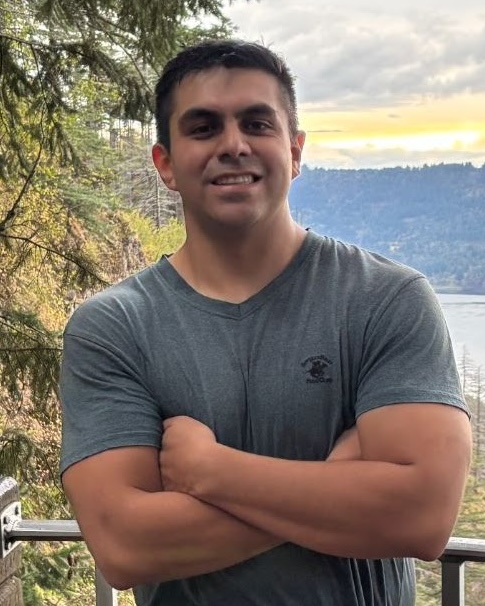
Sergio was born and raised in Mexico City. He studied Mathematics at Autonomous National University of Mexico (UNAM), a multicultural beacon where he was exposed to diverse ideas and opinions from multiple academic and cultural perspectives. Here he began his specialization in geometry supervised by Adriana Ortiz-Rodríguez. He later moved to the United States, where he obtained a PhD from Penn State University under the guidance of Anton Petrunin. After finishing his studies, Sergio spent two years in Germany working at the Max Planck Institute for Mathematics in Bonn under the mentorship of Stephan Stadler. Later, he returned to the United States, where he currently works as a postdoctoral scholar at Oregon State University, mentored by Christine Escher.
Sergio’s research is on geometric group theory, the study of how symmetry interacts with geometric and topological features of geometric objects. His PhD work focused on how the fundamental group behaves under geometric convergence, assuming a certain amount of symmetry. He proved that if a sequence of Riemannian manifolds converges to a point, and their universal covers converge to a limit space, that limit space is simply-connected, assuming it is finite-dimensional. Currently, his PhD student, Logan Richard, is working on removing the finite-dimensionality assumption.
Together with Qin Deng, Jaime Santos-Rodriguez, Xinrui Zhao, and Xingyu Zhu, Sergio has obtained important results on the symmetries of non-smooth spaces with lower curvature bounds. They have extended results from Riemannian geometry to more abstract spaces, illuminating the role of curvature bounds in the study of symmetry.
Jesús Núñez-Zimbrón, Jaime Santos-Rodríguez, and Sergio have also studied how symmetries themselves behave under geometric convergence. Inspired by previous notions created by Turing and Hrushovski, they have developed an abstract framework that studies the groups of isometries themselves without making explicit reference to the spaces they act on. Using this framework, they have proven that the symmetry degree is upper semi-continuous under non-collapsed convergence. Roughly speaking, this means that if a sequence of geometric objects converges to a limit object without collapsing, the limit space will have at least as much symmetry as the spaces in the sequence.
Sergio has created two animated mathematics YouTube courses on differential geometry and Riemannian geometry for the channel “What-is-math” he manages. He aims to continue creating accessible mathematical content for everyone around the world.
Sergio was also part of the organizing team of the 2025 and 2026 iterations of Math For All in Corvallis, a yearly conference fostering inclusivity in mathematics by holding talks and discussions in both research and education.
“To me, Hispanic Heritage Month is an opportunity for everyone to reflect on the personal and collective stories of the Hispanic community. I believe this opportunity should be used, on one hand, to showcase the experiences, struggles, and contributions of members of our community, and on the other hand, to strive for better norms and policies that create a more fair and just society for everyone.”


