Lathisms
Creative Template
for Webflow
for Webflow

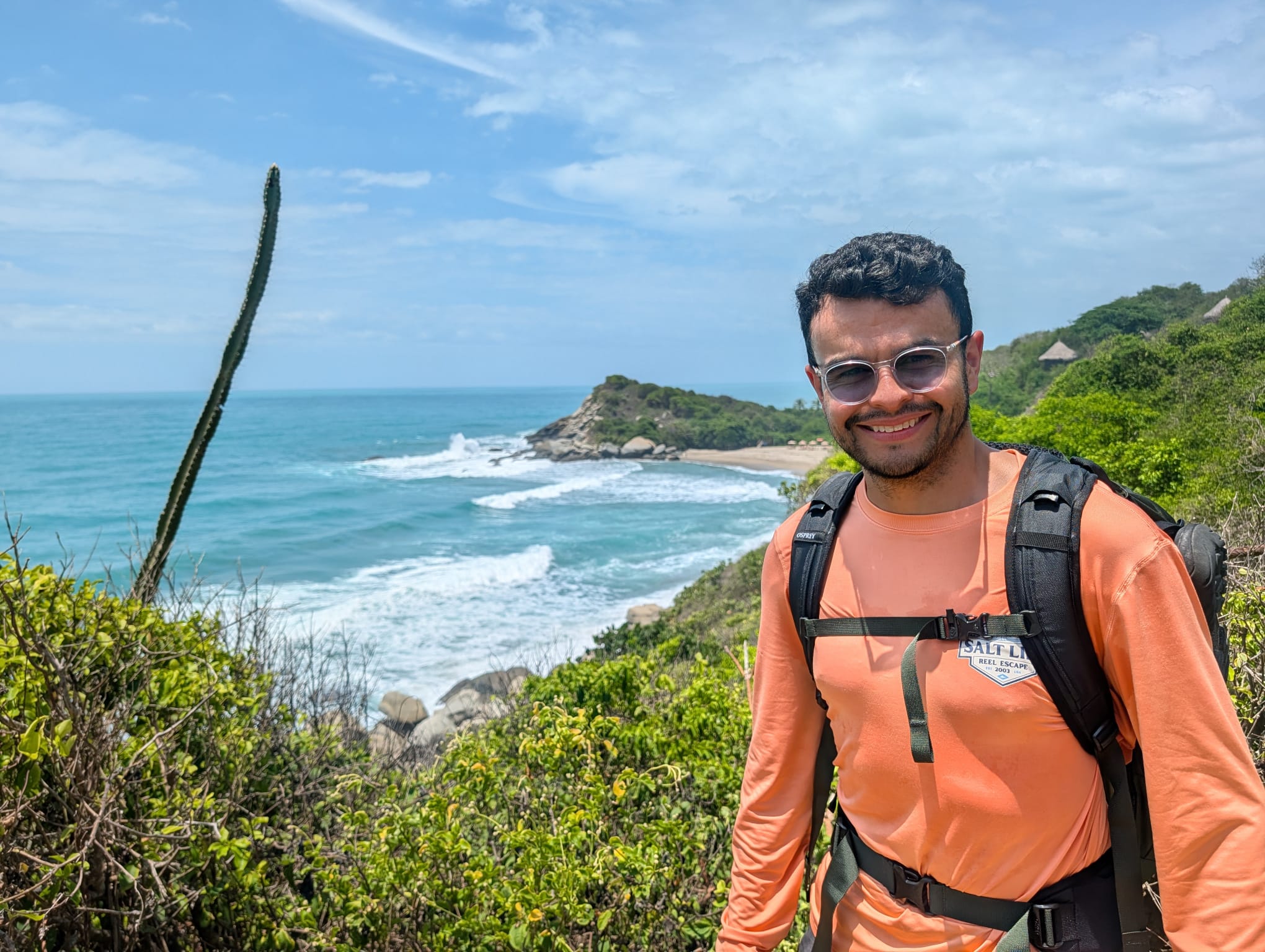
Fernando Díaz Morera was born in La Palma, a small town in northwest Cundinamarca, Colombia. He lived there until age 12, helping his family with daily farm chores such as tending to cattle, harvesting coffee and cocoa, and cutting sugarcane to make panela (unrefined whole cane sugar). While the region's stunning green landscapes all hold fond memories, one place was especially dear to him: the tiny library in his abuela’s house, where he spent hours diving into poetry, geography, and science. Driven to Bogotá by Colombia's internal conflict, Fernando stood out in mathematics and chemistry at a local public high school, supported by his parents, science teachers, and cousin. Hard work and good fortune earned him a scholarship to Universidad Sergio Arboleda, where he built a strong circle of friends who encouraged him to keep aiming high. Fernando went on to complete his master’s degree at the Instituto Politécnico Nacional in México and earned his Ph.D. in mathematics from Tulane University in 2024 under the supervision of Professor Mahir Bilen Can. He then moved to Fitchburg, Massachusetts, beginning as a Visiting Assistant Professor before joining the tenure track alongside a warm, welcoming, and close-knit math faculty.
Fernando’s research spans a diverse range of mathematical fields, from algebraic geometry to representation theory and combinatorics, naturally evolving alongside his collaborative environments and academic interests. For his doctorate, he focused on algebraic groups—mathematical structures that capture continuous symmetry—and the geometric spaces upon which they act, known as varieties. More recently, Fernando’s focus has shifted toward algebraic coding theory and cryptology, utilizing algebraic and combinatorial methods to study error-correcting codes and cryptographic systems. He actively involves undergraduates in projects that connect abstract algebra, combinatorics, and coding implementations. Under his mentorship, students have explored cutting-edge, future-proof cryptography and successfully presented their findings at academic conferences, making advanced mathematical concepts engaging and accessible for the next generation of scholars.
Alongside this work, he and Dr. Diego Villamizar have co-advised undergraduate honors theses at Universidad Sergio Arboleda, exposing students to cross-border academic collaboration. Fernando's mathematical journey is deeply fueled by his passion for teaching and knowledge sharing. He is a strong advocate for active learning practices, innovative pedagogies, and alternative grading systems. Furthermore, his work developing Open Educational Resources (OER) for linear algebra and precalculus demonstrates his proactive approach to removing financial barriers to student success, ensuring that high-level mathematics remains accessible to students from all economic backgrounds.
“Hispanic Heritage Month is a space to be rebellious, humble, loving, and inspiring, all at once. What we celebrate is only the tip of the iceberg: the countless contributions of Hispanic and Latinx individuals across every field are a powerful testament to our community. I am deeply grateful to those who inspire us through their achievements and create spaces where we can all share our own ideas.”


