Lathisms
Creative Template
for Webflow
for Webflow

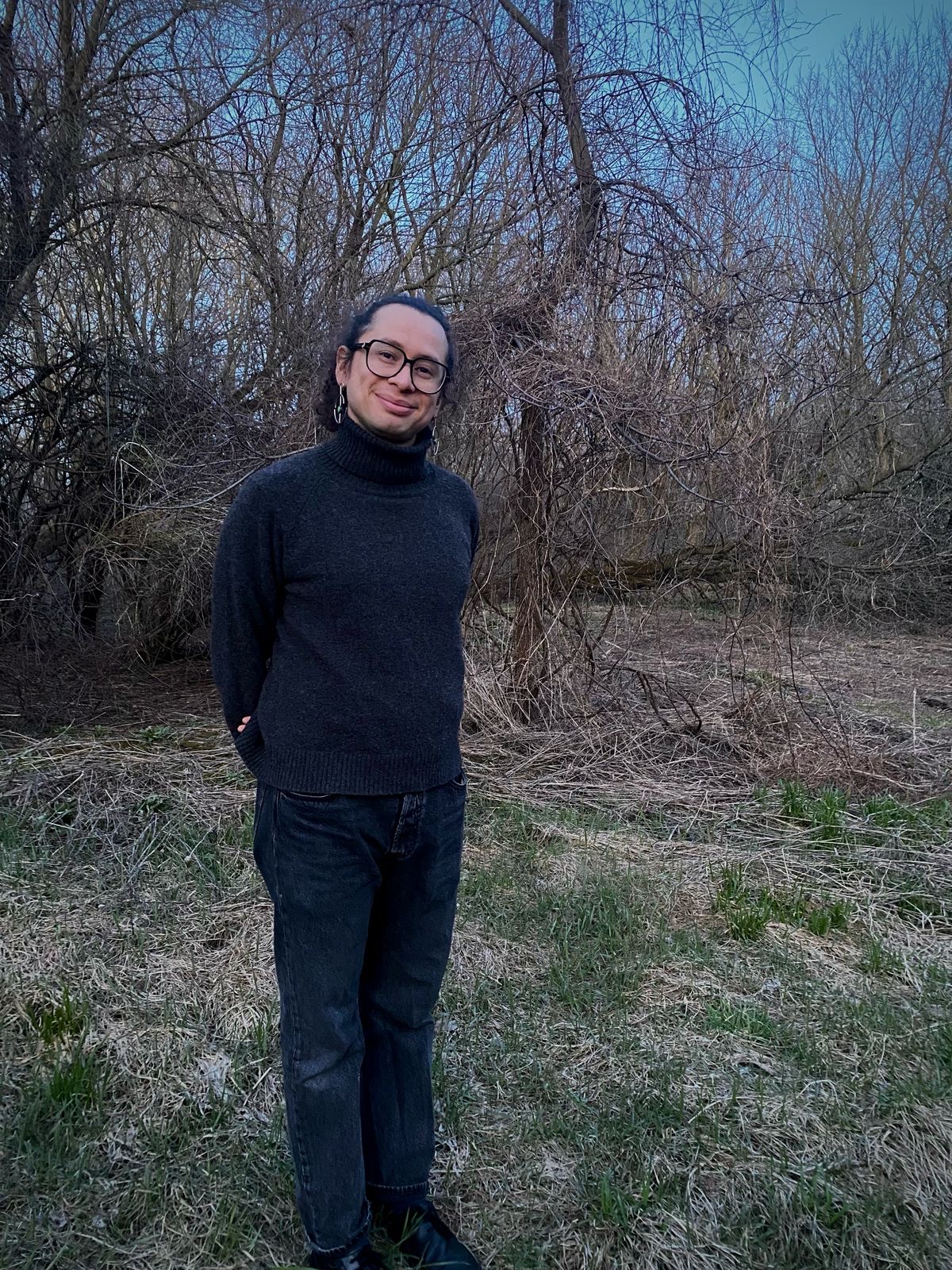
Diego Manco was born in Giraldo, Antioquia, a small town in the western range of the Colombian Andes. He received a BS in Mathematics from the Universidad de Antioquia in Medellín, an MS in Mathematics from the Universidad Nacional de Colombia in Bogotá, and a PhD in Mathematics from the University of Oregon in Eugene, OR, USA. For his PhD studies, he received a Fulbright scholarship from the Colombian Ministry of Science (then COLCIENCIAS). His PhD advisor was Angélica Osorno, a Colombian mathematician who has also been featured in Lathisms. He then was a Postdoctoral Associate at Western University in London, ON, Canada. He is now on the job market.
During his years in Colombia, Diego was interested in mathematical logic, and he wrote an MS thesis exploring connections between point-free topology, lattice valued first order structures, and sheaves of first order structures on locales. Diego is currently an algebraic topologist working at the intersection of Homotopy Theory and Category Theory. He has made contributions to algebraic K-theory by developing multicategories as a foundation for multiplicative K-theory, and by studying the connections between K-theory and other algebraic notions, such as Witt vectors.
He has taught undergraduate courses in Colombia, the United States, and Canada, has run graduate reading seminars, and mentored undergraduate reading projects. He has also helped with initiatives that connect the universities where he has worked with the surrounding communities, such as the Eugene Youth Math Fest and the Western Mathematics Exposition Competition.
“I am proudly descended from both Indigenous and Hispanic peoples. Hispanic Heritage Month is a chance to celebrate the whole range of our roots: the Spanish language that connects us, and our Indigenous and African heritage that is often overlooked. I have learned lots of mathematics in Spanish, from mathematicians such as Angélica Osorno, Fernando Zalamea, and Diego Mejía. I am inspired by the generations of Latin American and Hispanic mathematicians who paved the way, and I hope my research and teaching help people in the Americas, the Caribbean, and beyond see there is a place for them in mathematics.”


